The Bombay Plan: Blueprint for Economic Resurgence by Sanjaya Baru & Meghnad Desai
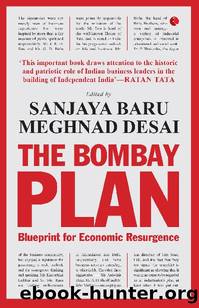
Author:Sanjaya Baru & Meghnad Desai [Baru, Sanjaya & Desai, Meghnad]
Language: eng
Format: epub
Publisher: Rupa Publications
Published: 2018-11-10T00:00:00+00:00
CULTURAL EXPERIENCES IN CHANGE MANAGEMENT
Change Management has developed in the field of management largely after the Second World War. The fruits of theory and practice in behavioural sciences has permeated into corporate management and seeped a bit into public policy as well. The fact is that the technical attributes of change are by themselves complexâdifficult to first, conceive and second, articulate into a cohesive wholeness. Having accomplished such a challenging task, transformers have realized that the human aspects of transformation are even more complexâwholly when articulated, and emotionally unpredictable during implementation. The cultural vector in executing change management is, in some respects, far more important to focus upon in transformation exercises at both corporate and national levels.
This has been made amply clear time and time again in the various initiatives that successive governments in India have tried to drive. One has to only look at the initial failed attempts to introduce Hindi as the national language in the South, the initial communications exhorting India to adopt family planning or even the recent Swacch Bharat campaign with its focus on building toilets, to understand how critical the human vector aspect of change management is, and the need for mindset change at the mass level.
Change management at the level of individual organizations is challenging enough. Executing a plan as wide in its conception as the Bombay Plan would be a herculean task by any standards. The architects of the Plan recognized the challenge in execution as that of âgetting the cooperation of the peopleâ. However, this was then reduced to resolving such a challenge by getting people âto read and writeâ so that they could be in a position to âunderstand for themselves the broad implications of the developments embodied in the Planâ. The only other obstacle in the execution of the Plan, as per the architects, was the large-scale training of personnel for technical posts in agriculture, trade, industry and for general administration, resembling the Soviet system.
However, even seventy-one years after India has achieved Independence, whether adult mass literacy (of the sort achieved by India) has been a panacea to any of the ills plaguing it, remains a moot question. Nor has technical advancement resolved the development concerns of India. In this sense, again, the Plan was naïve in its conception and implementation.
With the benefit of hindsight and newly mined knowledge, we can today, in an act of constructive criticism, say that the Bombay Plan was woefully inadequate in the area of the human vector of change management. Indeed, it is a moot point whether, on an ongoing basis in national public policy, there is sufficient attention paid to, and learning derived from, cultural experiences in change management. Within companies, the awareness is high, and the attempt to incorporate behavioural techniques is expanding rapidly. It is, of course, far more difficult to do so in a country with as large and diverse a population as India. However, recognizing the cultural vector of change management is exceedingly important in planning and execution of change and must feature more prominently in national planning initiatives.
Download
This site does not store any files on its server. We only index and link to content provided by other sites. Please contact the content providers to delete copyright contents if any and email us, we'll remove relevant links or contents immediately.
Life 3.0: Being Human in the Age of Artificial Intelligence by Tegmark Max(5558)
The Sports Rules Book by Human Kinetics(4388)
The Age of Surveillance Capitalism by Shoshana Zuboff(4293)
ACT Math For Dummies by Zegarelli Mark(4049)
Unlabel: Selling You Without Selling Out by Marc Ecko(3663)
Blood, Sweat, and Pixels by Jason Schreier(3624)
Hidden Persuasion: 33 psychological influence techniques in advertising by Marc Andrews & Matthijs van Leeuwen & Rick van Baaren(3565)
The Pixar Touch by David A. Price(3439)
Bad Pharma by Ben Goldacre(3428)
Urban Outlaw by Magnus Walker(3396)
Project Animal Farm: An Accidental Journey into the Secret World of Farming and the Truth About Our Food by Sonia Faruqi(3221)
Kitchen confidential by Anthony Bourdain(3090)
Brotopia by Emily Chang(3056)
Slugfest by Reed Tucker(3004)
The Content Trap by Bharat Anand(2927)
The Airbnb Story by Leigh Gallagher(2857)
Coffee for One by KJ Fallon(2637)
Smuggler's Cove: Exotic Cocktails, Rum, and the Cult of Tiki by Martin Cate & Rebecca Cate(2541)
Beer is proof God loves us by Charles W. Bamforth(2463)
